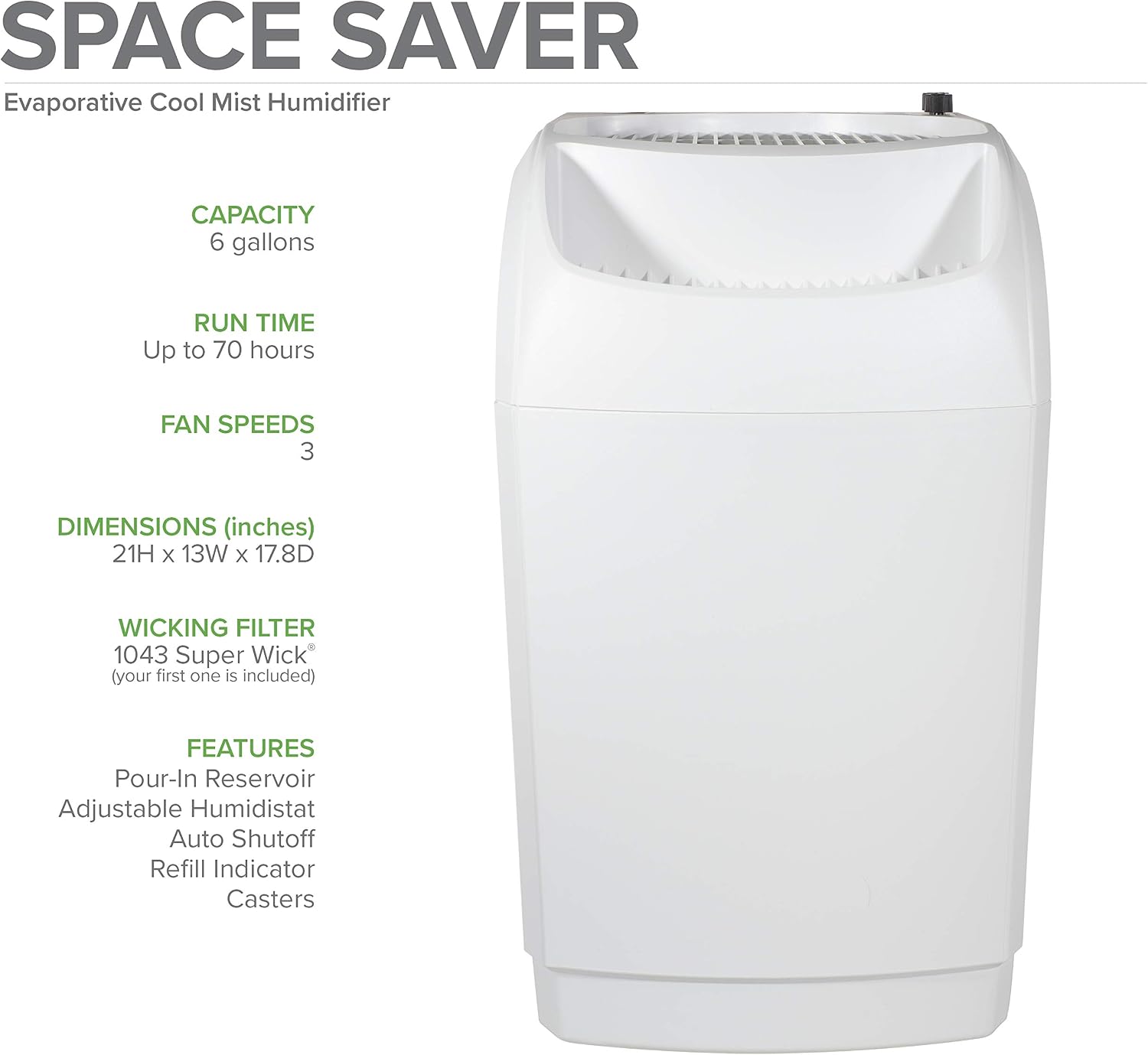
If you’ve ever walked into a hardware store in January and grabbed a tall, wheeled humidifier off the shelf — the kind you fill from the top and plug into a regular outlet — you’ve encountered a console humidifier. It does one thing: evaporate water into the air of whatever room it’s sitting in. That’s useful. But a whole-house humidifier, by contrast, attaches directly to your home’s central heating system and adds moisture to the air before it circulates through every register at once. The question this article answers is simple: when does the console approach stop being “good enough,” what exactly do you give up, and how do you make the call cleanly for a current project?
If you’re specifying a system for a client, pricing out a custom-home build, or trying to figure out why a 4,000-square-foot house with two AIRCARE MA1201 units still has cracked trim in January — this is the comparison you need.
The Core Mechanical Difference (and Why It Matters More Than Capacity Numbers)
Let’s be precise about what each product category actually is.
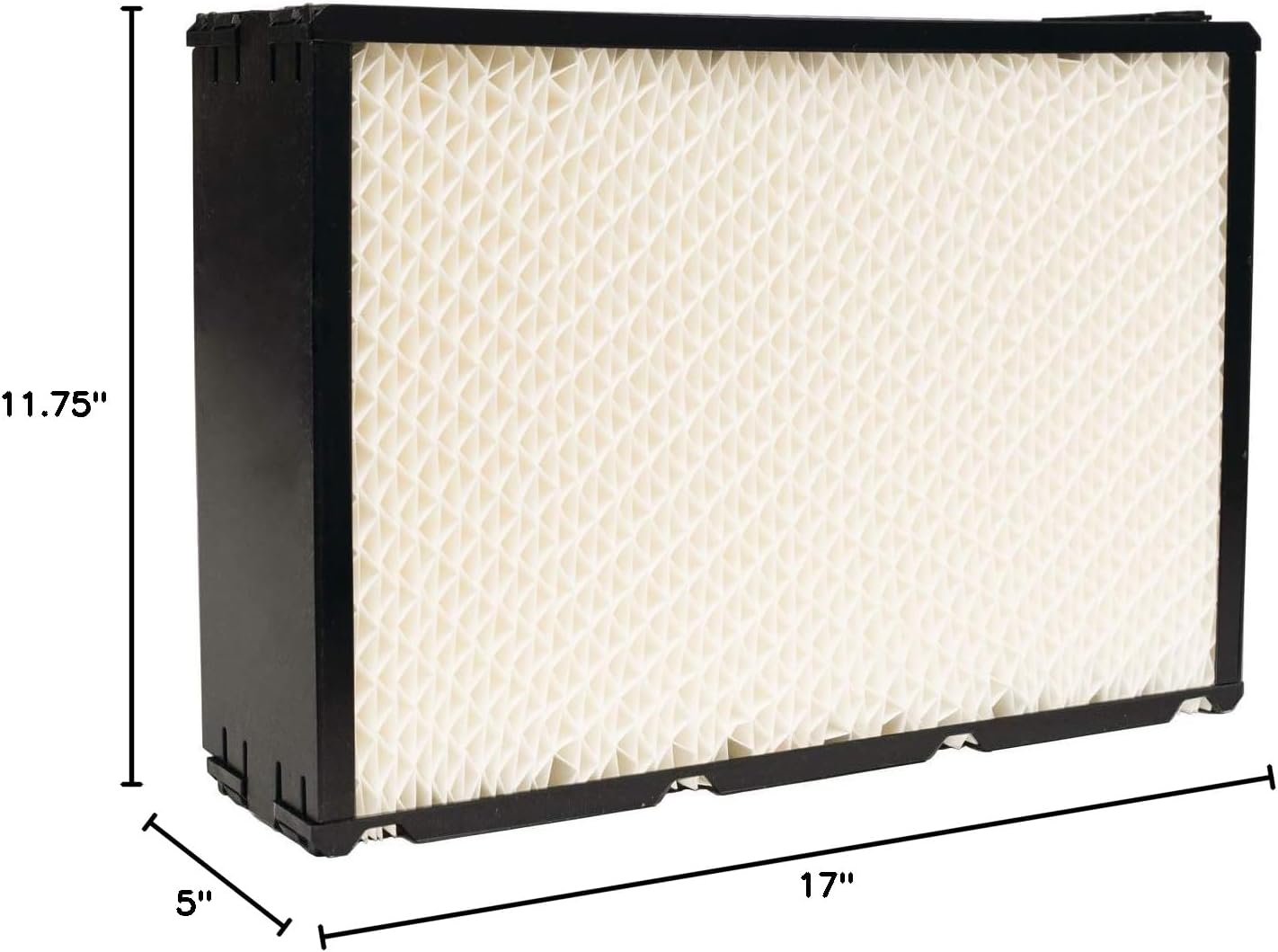
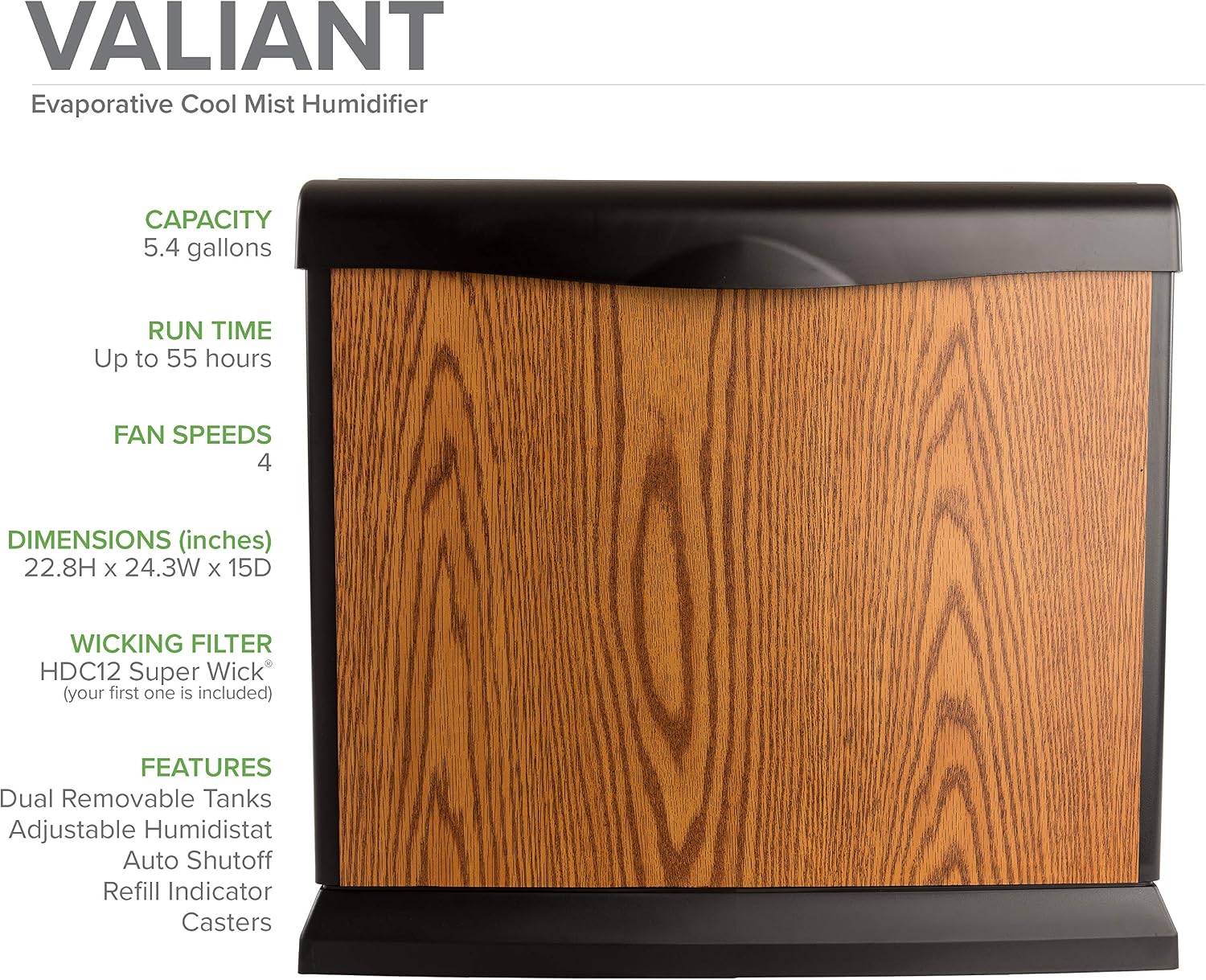
AIRCARE console units — the MA1201, the EA1208, the 831000 Space-Saver — are evaporative wick humidifiers. A fan pulls room air through a saturated wick filter; moisture evaporates into that air and gets blown back into the space. The unit sits on the floor, holds roughly 3–6 gallons in its reservoir, and is limited to the room (or open floor plan) it occupies. AIRCARE markets their largest units as covering up to 3,600 square feet, but that rating assumes ideal conditions — open layout, consistent temperatures, no moisture loss through doors or walls.
Furnace-mount units — bypass drum humidifiers like the Aprilaire 400 or Honeywell HE360, fan-powered flow-through units like the Aprilaire 600, and steam injection units like the AprilAire 865 or GeneralAire Elite GFI — connect to the supply or return plenum (the large duct box directly attached to your furnace) and introduce moisture into the central airstream. Every register in the house becomes a delivery point. The furnace’s blower does the distribution work.
This architectural difference drives everything downstream.
Coverage is not the same as distribution. A console unit saturates the air near it and relies on natural air mixing — convection, foot traffic, open doorways — to spread that humidity. Building Science Corporation’s BSD-013: Humidity documents moisture stratification in homes without forced-air mixing as a real and measurable phenomenon. In practice, rooms two or three doors away from a console unit consistently read 10–15 RH% lower on a hygrometer than the room the unit occupies. A furnace-mount system doesn’t have this problem: the blower delivers humidified air to every supply register simultaneously.
Run time and attention load are structurally different. A 6-gallon console reservoir — even at the modest output rate of a large AIRCARE — will exhaust in 12 to 24 hours under real winter conditions in a dry climate. Someone has to fill it. A bypass humidifier on a dedicated water line runs until you turn it off. For a rental property, a second home, or a client who travels, this is not a minor point — it’s a maintenance-contract line item or a support call waiting to happen.
Head-to-Head: Three Tiers of Humidification Hardware
The comparison below covers the three main categories a practitioner or informed homeowner will actually choose between. Each tier maps to a different budget and use case.
Budget Tier — AIRCARE MA1201 Large Console
The MA1201 is the flagship of AIRCARE’s console lineup. Manufacturer-rated output sits at roughly 12 gallons per day maximum; coverage is marketed at up to 3,600 square feet. Unit retail runs $150–$250. Installation is plug-in only — no HVAC tie-in, no plumbing, no licensed contractor required.
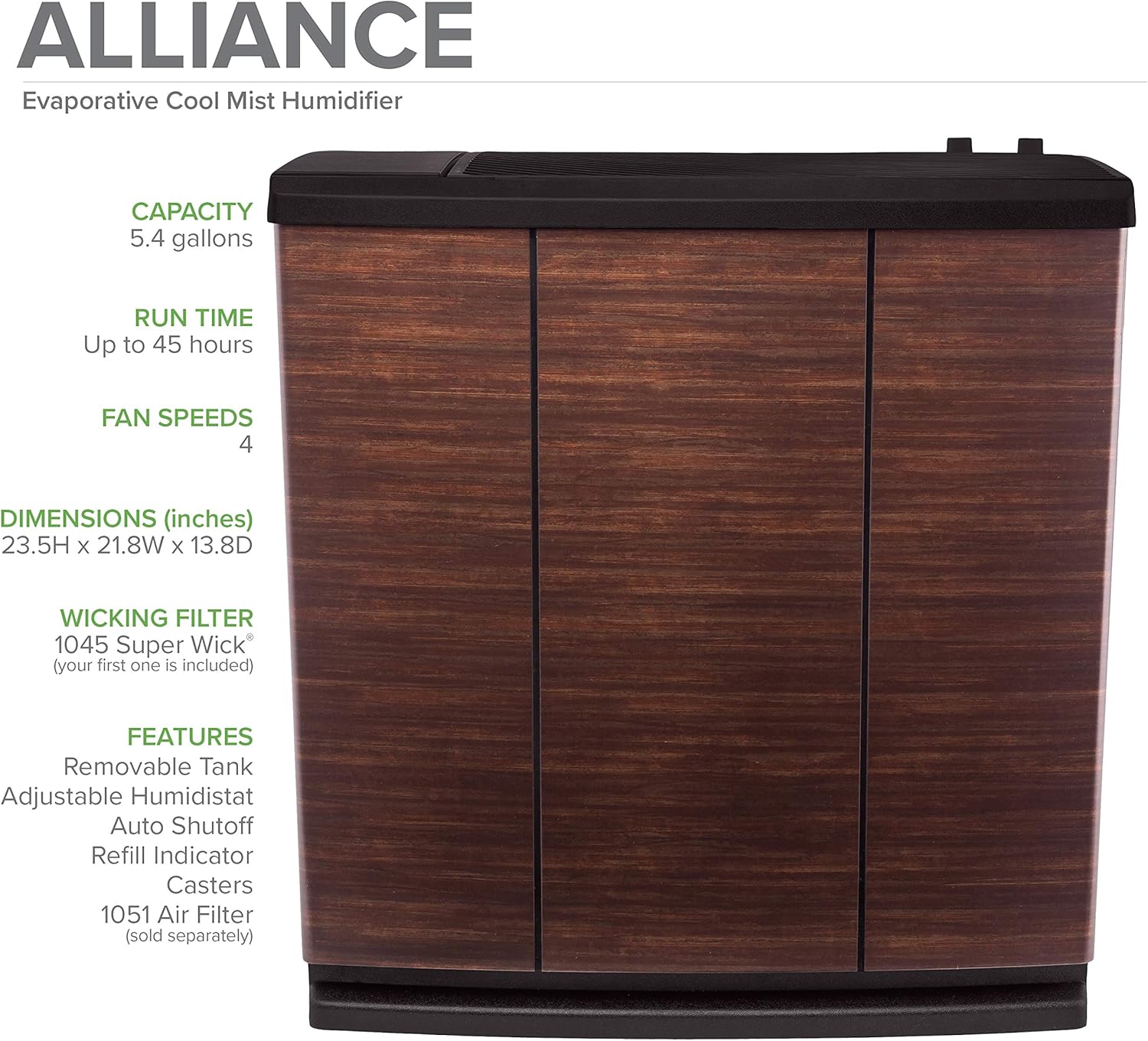
The wick filter requires replacement every 4–8 weeks in hard-water areas (above 15 grains per gallon, common across the Midwest and Mountain West). At $15–$25 per filter, a five-month heating season in a hard-water zip code costs $45–$125 per unit in consumables alone. Running two or three units to attempt whole-home coverage multiplies that figure. The unit has a built-in humidistat but no connection path to a smart thermostat or outdoor temperature sensor.
Best fit: Single rooms, finished basements, spaces with no ductwork, or rental units where upfront simplicity outweighs long-term efficiency.
AIRCARE
$25.94
In stock on Amazon
Check price on AmazonMid-Tier — Aprilaire 400 Bypass Drum Humidifier
The Aprilaire 400 is a bypass drum unit that taps into the supply or return plenum and uses furnace heat to drive evaporation from a rotating drum pad. Manufacturer-rated output is 17 gallons per day; coverage up to 4,000 square feet. Unit retail runs $150–$220. Installed cost with a licensed HVAC contractor — plenum tap, saddle valve on the cold water supply, and low-voltage wiring to the furnace control board — typically lands at $500–$700 all-in for a straightforward installation on an accessible furnace.
Annual drum pad replacement at $15–$30 is the primary maintenance cost. The unit wires to the HUM terminal on compatible thermostats (Ecobee, Honeywell T10, and others), enabling frost-protection logic that automatically reduces the humidity setpoint when outdoor temperatures drop to a range where window condensation becomes a risk. This Old House’s overview of whole-house humidifiers identifies this thermostat integration as one of the key operational advantages of furnace-mount systems over portable units.
Important limitation: bypass drum units depend on warm supply air to drive evaporation. On a heat-pump air handler running at 95–98°F supply temperature, output drops materially. This unit is optimally paired with a gas or oil furnace.
Best fit: Gas or oil furnace homes up to 4,000 square feet; clients who want smart-thermostat integration without the cost premium of a steam unit.
AIRCARE
$189.99
In stock on Amazon
Check price on AmazonPremium Tier — Aprilaire 600 Fan-Powered Flow-Through or Steam Unit (AprilAire 865 / GeneralAire Elite GFI)
Fan-powered flow-through units like the Aprilaire 600 add an integrated blower so the unit pulls air through the water panel independently of whether the furnace blower is running. This extends operational hours and makes the unit viable in heat-pump systems where supply air temperatures are lower. Manufacturer-rated output is 17 GPD; retail runs $200–$280. Installed cost is comparable to the bypass drum — $550–$750 in most markets.
Steam units (AprilAire 865, GeneralAire Elite GFI) are fully independent of supply air temperature and are the correct specification for high-performance homes with heat pumps, Ecobee with full outdoor-sensor integration, or Savant/Crestron smart-home ecosystems. The heating element boils water directly; steam is injected into the duct. Steam units carry the highest unit cost ($400–$700 retail) and the highest installed cost ($900–$1,400 all-in), but they provide the most precise, closed-loop humidity control available in a residential product. The control cylinder is the primary wear item and requires annual inspection; sophisticated units flush automatically based on water conductivity, making maintenance scheduled rather than reactive.
ASHRAE Standard 55-2023, Thermal Environmental Conditions for Human Occupancy, sets occupant comfort relative humidity between approximately 30% and 60% throughout occupied spaces. Steam units with full thermostat integration are the only residential category that reliably maintains that band simultaneously across every zone in a multi-story, compartmentalized floor plan.
Best fit: Heat-pump homes, high-performance new construction, smart-home integration requirements, or any client where precise whole-home humidity uniformity is the primary specification criterion.
AIRCARE
$204.99
In stock on Amazon
Check price on AmazonWhat You Actually Give Up With the Console Approach
This section is the honest accounting. AIRCARE consoles are not bad products — for a single room or a space without ductwork, they are legitimate tools. But when the application is a whole, ducted home, here is what the spec sheet will not tell you.
Humidity uniformity. A console unit can’t guarantee consistent relative humidity across a multi-zone home. The living room where the unit sits will read fine; the upstairs bedrooms and the home office at the end of a hallway will not. This matters for wood floors, musical instruments, and occupants with respiratory conditions. Building Science Corporation’s BSD-013: Humidity is explicit on this point: unforced air mixing in a house is slow and spatially uneven.
Smart-thermostat integration. Furnace-mount humidifiers wire to the HUM or ACC terminal on an Ecobee, Nest, or Honeywell T10. The thermostat reads outdoor temperature and applies frost-protection logic — automatically reducing the humidity setpoint when it’s cold enough outside that moisture would condense on window glass. AIRCARE consoles have no such integration path. In a house running an Ecobee with an outdoor sensor, the console is either over-humidifying (risking window condensation and mold) or under-humidifying (defeating the purpose). You cannot close that loop without the HVAC tie-in.
Heat-pump system behavior. As heat-pump systems displace gas furnaces — a trend accelerating through 2025–2026 in the Sun Belt and Pacific Northwest — bypass drum humidifiers lose their primary mechanism. A bypass unit on a heat-pump air handler running at 95–98°F supply temperature barely evaporates. Fan-powered and steam units solve this problem. Console units are also immune to it, but that’s a limited bright spot: the console is a workaround for a single room, not a solution for a whole home on a heat-pump system.
Water quality and maintenance scaling. The EPA’s indoor air quality guidance on moisture control notes that standing water in reservoirs — the design basis of every console humidifier — creates a surface for bacterial and mold growth if not cleaned on a consistent schedule, typically every one to three weeks. Furnace-mount flow-through and steam units don’t use standing reservoirs. The water-panel or drum-pad maintenance cycle is annual rather than weekly, and the failure mode is reduced output rather than a microbial reservoir.
The Decision Framework: If X, Then Y
If the home has central forced-air HVAC and ductwork: Specify a furnace-mount unit. Coverage uniformity, smart-thermostat integration, and long-term maintenance economics all favor it. The installed-cost premium over a console is real ($400–$600 more all-in for a bypass drum), but it closes by year two when you account for filter consumables, the risk of water damage from uneven humidity, and the service call in February when a client reports gapping floors.
If the home runs a heat pump as the primary heating source: Do not specify a bypass drum. Specify a fan-powered unit (Aprilaire 600 or equivalent) or a steam unit. The console is not the answer here either — it just trades one limitation for another.
If the application is a single room, a basement apartment, or a space with no ductwork: The AIRCARE console is the correct tool. It is inexpensive, requires no installation, and performs well within its intended scope.
If the client is specifying a high-performance home with full smart-thermostat integration: A steam unit with low-voltage control wired to the thermostat’s HUM terminal is the only approach that provides closed-loop humidity control across every zone. The AIRCARE console is architecturally incompatible with this use case.
If the project is a rental or second home: Factor in the reservoir-fill labor before recommending a console for whole-house coverage. A single bypass drum on a plumbing tie-in, paired with a thermostat offering remote access, is a more defensible specification for an inattentive or absent occupant.
The Bottom Line
The AIRCARE console is a capable, honest product doing exactly what it was designed to do: add moisture to a room. The marketing language around “whole-home coverage” is where things get slippery. Building Science Corporation’s BSD-013: Humidity research is clear that unforced air mixing in a compartmentalized house is slow and uneven, and real-world console performance in multi-room floor plans consistently underdelivers on the coverage claim.
For practitioners with a project under specification: the furnace-mount unit wins on every axis that matters at the whole-home scale — distribution uniformity, smart-thermostat integration, maintenance burden, and long-term cost of ownership. The console’s only structural advantages are zero installation cost and heat-pump immunity, and neither of those is a reason to choose it when the application demands genuine whole-home humidity control.
Name the tradeoff to your client before you name the pick. Then the pick is easy.