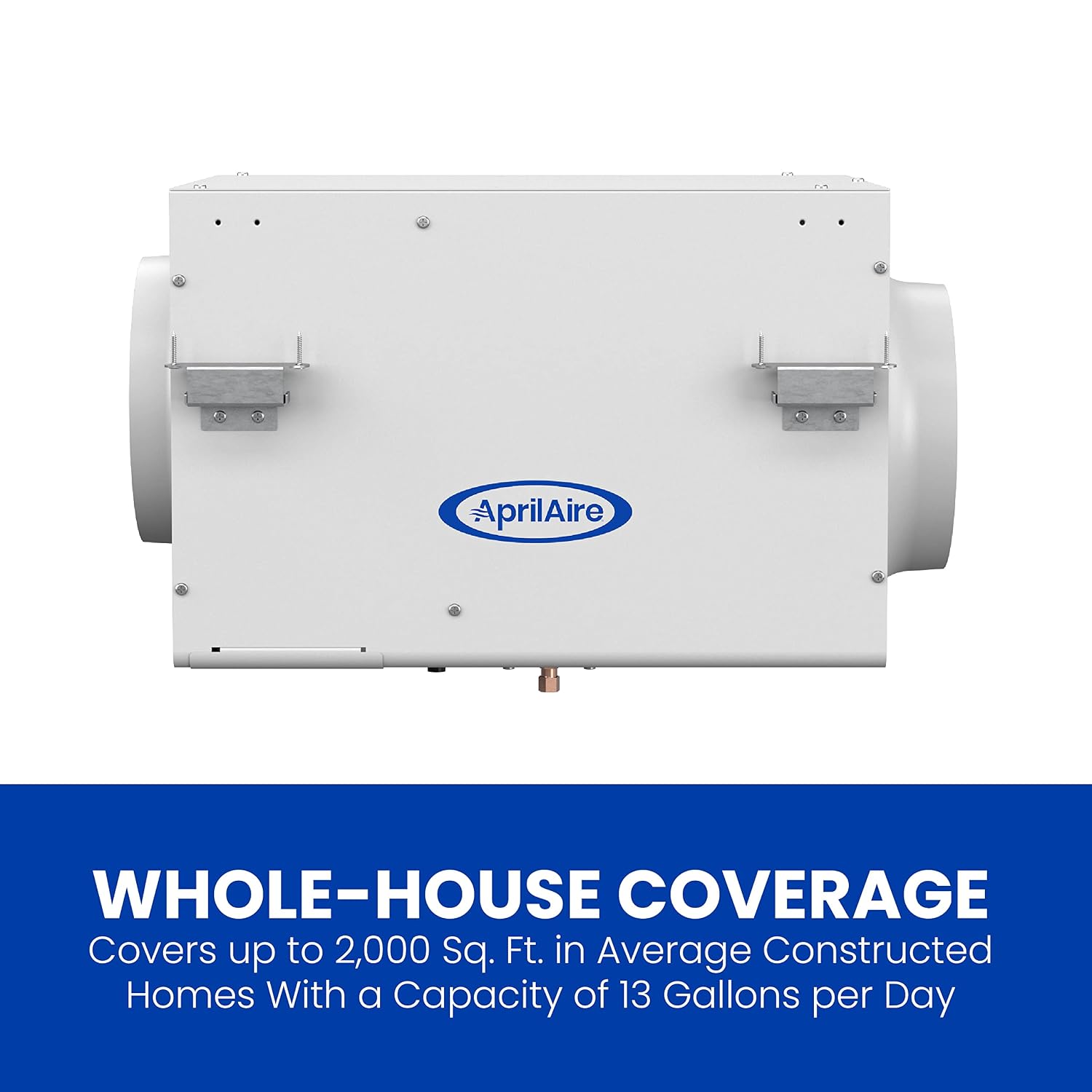
Most whole-house humidifiers are designed to bolt onto a forced-air furnace — they ride the ductwork, borrowing the blower fan and the warm airstream to push moisture into every room at once. That works beautifully if you have a furnace. But a growing share of American homes heat with hydronic systems (think: hot-water radiators or radiant floor tubing fed by a boiler) or with mini-splits (wall-mounted units that condition one zone at a time, with no central duct network at all). In those homes, the standard whole-house humidifier playbook doesn’t apply. The AprilAire 300 is one of the few products specifically designed to fill that gap — it generates humidity on its own, without needing a furnace blower or a duct plenum (the large sheet-metal box that connects to your furnace). This article examines what that design choice actually means for sizing, installation, maintenance, and long-term cost of ownership so you can decide whether the 300 fits your situation or whether a different approach makes more sense.
What “Self-Contained” Actually Means — and Why It Matters for Non-Forced-Air Homes
The phrase “self-contained” sounds like marketing, but in this context it has a precise mechanical meaning. A conventional bypass humidifier (like the AprilAire 400 or Honeywell HE360) has no fan of its own. It relies entirely on the pressure differential between your supply and return air ducts to push air through a water panel. No furnace airflow, no humidification — which is exactly why bypass units are useless in boiler or mini-split homes.
The AprilAire 300 is an evaporative (not steam) self-contained unit. It includes its own internal fan that draws room air through a water-soaked evaporator panel and pushes humidified air back into the space. Rated capacity is 0.75 gallons per day (GPD) per the AprilAire Model 300 Installation and Maintenance Manual — modest by whole-house steam standards, but the spec sheet specifies it as suitable for homes up to approximately 1,300 square feet under average conditions.
That 1,300-square-foot ceiling is the first number worth interrogating.
By the numbers:
| Spec | AprilAire 300 |
|---|---|
| Humidification output | 0.75 GPD (rated) |
| Rated coverage | Up to ~1,300 sq ft |
| Operating temperature range | 65–85°F ambient |
| Water supply requirement | Standard 1/4” saddle-valve connection |
| Electrical | 120V, standard outlet |
ASHRAE Standard 62.1-2022 recommends maintaining indoor relative humidity between 30% and 60% for acceptable indoor air quality in occupied spaces. Getting to 35% RH in a well-sealed 1,300-square-foot home during a cold snap — when the outdoor dew point might be in the single digits — demands more evaporative capacity than the 300 can reliably deliver. Building Science Corporation’s BSD-013 on humidity control notes that effective whole-house humidification load is driven not just by square footage but by envelope tightness, ceiling height, and the rate at which dry outdoor air infiltrates. An older home with leaky windows and 9-foot ceilings at 1,200 square feet may need twice the GPD output of a tight new build at the same floor area.
The honest framing: the AprilAire 300 is appropriately sized for a modest, reasonably tight home — or for a single zone of a larger one. It is not a replacement for a 12-GPD steam unit if you’re trying to condition 3,000 square feet of Victorian-era balloon-frame construction.
Installation Realities: Where the 300 Fits (and Where It Doesn’t)
Installation is where the 300 earns its “self-contained” billing most convincingly. Because it doesn’t need ductwork, it mounts directly on a wall or can be surface-mounted in a mechanical room, utility closet, or basement. Per the AprilAire installation manual, it requires:
- A 120V outlet within reach (standard household current, no dedicated circuit required)
- A cold-water supply line (1/4” connection via saddle valve)
- A drain line (gravity drain to a floor drain or condensate pump)
That’s it. No sheet-metal work, no duct penetrations, no 24V control wiring back to a furnace control board. For a licensed plumber or experienced DIYer, the rough-in is a few hours. ACHR News’s 2025 mini-split market report notes that IAQ retrofits in ductless homes remain one of the fastest-growing service categories precisely because the existing install base has no infrastructure for conventional humidification — and contractors are hungry for products that don’t require a duct retrofit to justify.
Where placement gets tricky: The 300 outputs humidified air into the immediate space. In a mini-split home where each zone is somewhat isolated (interior doors closed at night, for example), a single unit in the basement won’t evenly distribute moisture to second-floor bedrooms. The physics of evaporative humidification mean moisture migrates slowly through still air. If whole-home uniformity matters — master bedroom at 38% RH, not just the mechanical room at 42% — you may need multiple units or a different approach entirely. This Old House’s whole-house humidifier buying guide makes the same point when discussing portable vs. integrated systems: location relative to occupied zones matters as much as rated GPD.
Boiler homes specifically: A hydronic boiler system often includes a basement mechanical room that is already warm and accessible. This is a natural mounting location for the 300, but verify that the unit’s internal fan can move enough air to serve adjacent living spaces — the 300 is not a powered duct distribution system. In a tight ranch-style home with an open floor plan, one unit in a central location can perform well. In a two-story colonial with the boiler in a closed basement, expect the second floor to lag.
The Water Quality Problem Nobody Warns You About
This is where most 300 owners eventually run into trouble, and it’s worth front-loading rather than burying.
The AprilAire 300 is an evaporative humidifier, which means it uses a replaceable water panel (AprilAire calls it a Water Panel Evaporator, part #35). As water evaporates, minerals in the supply water are left behind on the panel. In areas with hard water — defined loosely as water with more than 7 grains per gallon (gpg) of dissolved minerals — scale accumulates rapidly. AprilAire recommends annual panel replacement under normal conditions, but owners in hard-water markets (the Great Plains, Southwest, and much of the Midwest) consistently report needing two replacements per season or more before the panel becomes so caked with scale that airflow and output drop noticeably.
At roughly $18–$25 per replacement panel (market pricing as of mid-2026), this is a manageable but real ongoing cost. The more important implication: if you’re in a hard-water ZIP code and you’re evaluating the 300 for a client or your own home, factor in either a pre-filter water softener or more frequent maintenance visits. Building Science Corporation’s BSD-013 specifically flags evaporative media fouling as the most common reason whole-house humidifiers fail to maintain target RH — not because the unit is undersized, but because the evaporative surface is choked with scale.
Steam units like the AprilAire 800 or GeneralAire Elite GFI handle this differently (they boil the minerals out and drain the concentrated water through a flush cycle), but they come with a 5–10x price premium and require a dedicated high-amperage electrical circuit. The 300’s operating cost advantage over steam is real — but only if you stay on top of panel maintenance.
Smart Thermostat Compatibility: A Meaningful Limitation
If you’re in the smart-home integrator segment, this section is the one that may settle the decision.
The AprilAire 300 controls humidity via its own built-in humidistat (a sensor that reads relative humidity and cycles the unit on and off). It does not have a 24V humidifier control terminal (the “HUM” or “H” terminal found on forced-air thermostats) because it was never designed to be wired into a furnace control board. This means:
- Ecobee: No native integration. The Ecobee’s humidifier control output assumes a relay-controlled humidifier wired to the furnace. The 300’s internal humidistat operates independently — you cannot set target RH from your Ecobee app or benefit from Ecobee’s frost-prevention algorithm, which adjusts target humidity downward when outdoor temps drop to prevent condensation on windows.
- Nest: Same limitation. The Nest Learning Thermostat’s HUM terminal behavior is designed for ducted systems.
- Standalone smart humidistats: This is the workaround. A device like the Inkbird IBS-TH3 or Honeywell Home H8908B humidistat can replace or augment the 300’s built-in control, allowing you to adjust setpoints remotely — but it’s an add-on, not native integration.
For smart-home integrators specifying a whole-home IAQ stack, the 300’s control architecture is a real constraint. If the client has an Ecobee with outdoor temperature compensation or a Savant system with IAQ dashboards, the 300 will sit outside that ecosystem unless you engineer a relay workaround. Worth naming explicitly in client proposals.
The Decision Frame: If X, Then Y
Here’s the honest summary after working through the specs and owner-reported patterns:
If your home is under 1,200–1,300 square feet, reasonably well-sealed, heated by a boiler or mini-split, and you’re primarily trying to keep one or two main living areas above 30% RH in winter — the AprilAire 300 is a cost-effective, low-installation-complexity solution. No ductwork, no dedicated circuit, no contractor required beyond a plumber for the water line. Plan on annual panel replacement (twice-annual in hard-water areas). Budget roughly $150–$200 for the unit plus $50–$100 for installation materials in a straightforward DIY scenario, or $250–$350 installed by a plumber.
If your home is larger than 1,500 square feet, multi-story, or has a ductless zone layout where rooms are frequently closed off — a single 300 will likely underperform. Consider either multiple units (one per zone) or stepping up to a steam system with a standalone humidistat. The AprilAire 800 (electrode steam, up to 34.6 GPD) is the canonical next step, though the installed cost — typically $800–$1,200 in mid-2026 contractor quotes — is a different conversation.
If smart-home integration with Ecobee, Nest, or a whole-home automation platform is a hard requirement — the 300’s standalone humidistat is a friction point. Either budget for a workaround relay circuit or specify a steam unit with a 24V control interface from the start.
If water quality is a known issue in your market — get a water hardness test before specifying any evaporative unit for a client. Above roughly 15 gpg, the annual panel cost and service calls can erode the 300’s cost advantage quickly. A steam unit with an automatic flush cycle may be a better long-term value even at higher upfront cost.
The AprilAire 300 is not a universal solution, and it doesn’t pretend to be. But for the specific problem it was built to solve — bringing reliable, self-contained humidity control to homes that have no furnace and no ductwork — it’s one of the few products that addresses the need directly without requiring a major infrastructure change. Know the sizing ceiling, manage the water quality, and set client expectations on smart-thermostat control, and it earns its place on the spec sheet.