If your home feels dry in winter — static shocks, cracking wood floors, nosebleeds at 2 a.m. — a whole-house humidifier is the fix. Unlike the plug-in units you set on a nightstand, a whole-house bypass humidifier connects directly to your home’s forced-air heating system and adds moisture to the moving air automatically, so every room benefits, not just one. The question isn’t really whether to buy one — it’s which one. AprilAire’s 500, 600, and 620 are the three bypass units the brand stakes its residential reputation on, and they’re priced close enough that the choice can feel like a coin flip. It isn’t. GPD — gallons per day, the standard measure of how much moisture a humidifier can actually push into your home — varies meaningfully across the three, and picking the wrong capacity is the single most common mistake practitioners encounter on repeat service calls. This guide will show you how to size correctly, lay out every real tradeoff, and give you a clean decision rule before you write the proposal.
What “Bypass” Actually Means — and Why It Caps Your Output
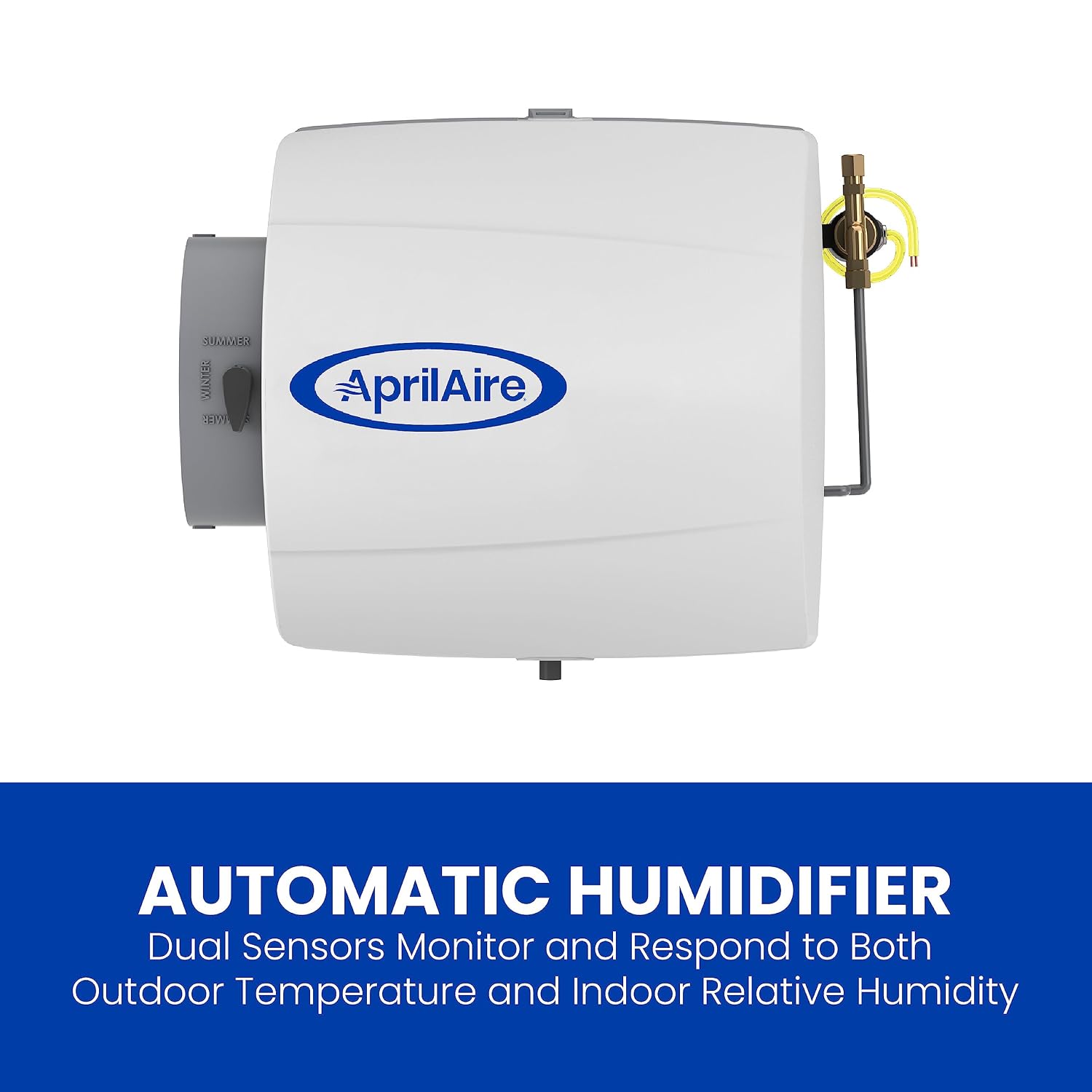
A bypass humidifier doesn’t have its own fan. It borrows airflow from your furnace’s blower, tapping a duct on the warm-air supply side and routing a portion of that airflow across a water panel — a pad saturated with water — before the now-humidified air returns to the living space. The furnace does all the heavy lifting. That’s why bypass units cost less than fan-powered models: fewer moving parts, no separate motor to wire or service.
The tradeoff — and this one matters for sizing — is that output is furnace-dependent. The blower has to be running for the humidifier to work. On a heat pump or a high-efficiency furnace running long, low-heat cycles, the blower runs less aggressively than on a conventional 80% AFUE gas furnace. ACHR News, in its whole-house humidifier sizing and selection reporting, identifies this furnace-dependency as one of the most underreported sources of field underperformance: the contractor sells the nameplate number, and the homeowner experiences 60–75% of it in a real installation.
Keep that in mind as you read the spec comparison below. The numbers are real; the context is what turns them into decisions.
The Three Models, Head to Head
AprilAire 500 — The Budget-Tier Bypass
The 500 is the entry point in the AprilAire bypass line. It is rated at 12 GPD of moisture output under ideal conditions. Per AprilAire’s published product specification sheets for Model 500, the unit is designed for homes up to approximately 3,000 square feet. It ships without a humidistat in the base configuration, though it is compatible with AprilAire’s Model 60 or 62 automatic controls purchased separately. The 500 uses a gravity-drain design — water that doesn’t evaporate drains off by gravity, requiring no pump. Simple, reliable, and low on service cost.
Best for: Homes under 2,500 sq ft, post-2000 construction with good air sealing, standard 8-foot ceilings, winter design temperatures above 15°F. Also correct when the client has a smart thermostat with built-in humidity control and budget is the primary constraint.
Watch out for: The 500’s 12 GPD ceiling leaves almost no margin in older, leakier homes or in climates where outdoor temperatures regularly fall below 0°F. Undersizing here is the source of the most common repeat service calls.
AprilAire
$44.49
In stock on Amazon
Check price on AmazonAprilAire 600 — The Mid-Tier Workhorse
The 600 is the mid-tier unit, rated at 17 GPD and sized for homes up to approximately 4,000 square feet according to AprilAire’s published specification sheets for Model 600. It shares the same bypass, gravity-drain architecture as the 500 but uses a larger water panel and higher flow rate to account for the output bump. The 600 is the most-installed AprilAire bypass model in the field — installer discussions documented in ACHR News and Contracting Business consistently describe it as the sweet spot between cost and capacity for a typical new-construction 2,500–3,500 sq ft home. It ships without a humidistat in the base configuration, the same as the 500.
Best for: Homes between 2,500 and 4,000 sq ft, or any smaller home where infiltration, ceiling height, or climate factors push the effective load above what the 500 can handle. Also the right choice over the 620 specifically when a smart thermostat with humidity-limiting capability is already in the proposal — the thermostat handles control logic, and the 620’s built-in humidistat becomes redundant.
Watch out for: On heat-pump systems, effective output can fall significantly below the 17 GPD nameplate. If the system is or will become a heat pump, the 600 may still underperform in a large home.
AprilAire
$276.43
In stock on Amazon
Check price on AmazonAprilAire 620 — The Premium-Control Bypass
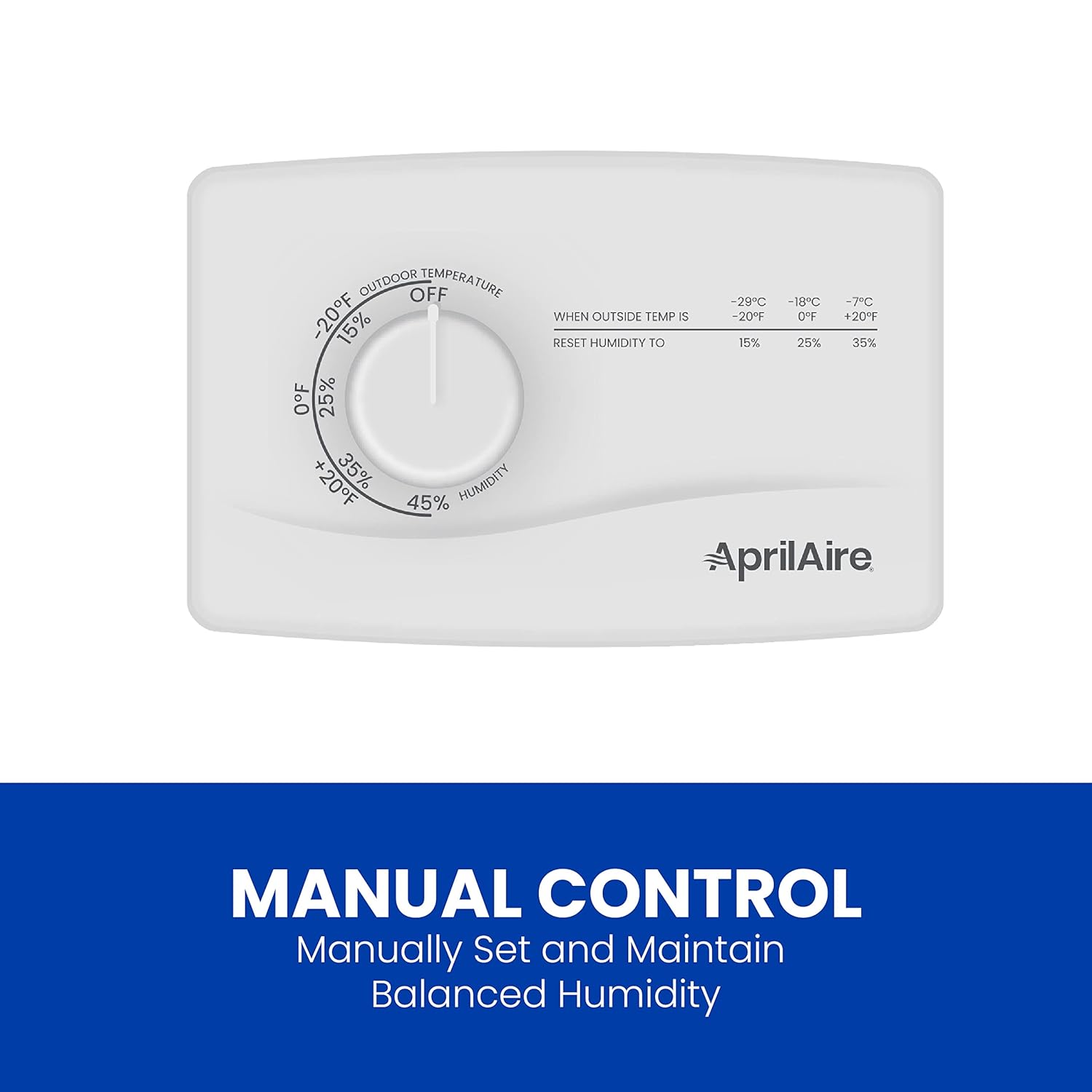
The 620 is the 600 with one meaningful hardware addition: a built-in automatic digital control — AprilAire’s Model 62 humidistat — included from the factory. The GPD rating is identical to the 600 at 17 GPD. You are not buying more capacity; you are buying smarter control. The Model 62 automatic control monitors both indoor humidity and outdoor temperature to scale back output before condensation forms on cold windows — a behavior that matters a great deal in cold climates. Installer and owner discussions documented in ACHR News consistently cite window condensation prevention as the primary reason practitioners specify the 620 over the 600 in northern-climate installations.
Best for: Same square-footage envelope as the 600, but the right pick when (a) no smart thermostat is in the proposal, (b) the client is in a climate where outdoor temperatures regularly drop below 10°F and window condensation is a real risk, or (c) your service model favors fewer callbacks. The $60–$80 unit-price premium over the 600 is a cheap insurance policy against the most common source of humidifier-related service calls.
Watch out for: If the installation already includes an Ecobee, Google Nest, or a Honeywell T-series thermostat with dewpoint-limiting mode, the 620’s built-in control duplicates functionality you’ve already paid for. In that scenario, the 600 is the correct specification and the premium buys nothing.

AprilAire
$1,459.99
In stock on Amazon
Check price on AmazonComparison at a Glance
| Model | GPD (rated) | Sq Ft Coverage | Control Included | Approx. Unit Price (2026) |
|---|---|---|---|---|
| AprilAire 500 | 12 GPD | Up to ~3,000 sq ft | None (add-on) | ~$130–$155 |
| AprilAire 600 | 17 GPD | Up to ~4,000 sq ft | None (add-on) | ~$165–$195 |
| AprilAire 620 | 17 GPD | Up to ~4,000 sq ft | Model 62 included | ~$220–$260 |
AprilAire
$44.49
In stock on Amazon
Check price on AmazonAprilAire
$276.43
In stock on Amazon
Check price on AmazonAprilAire
$1,459.99
In stock on Amazon
Check price on AmazonUnit prices reflect typical distributor pricing as of May 2026. Installed cost adds $150–$350 for labor depending on market and installation complexity. Source: AprilAire published specification sheets; regional distributor pricing surveys.
The Real Sizing Math — Not the Marketing Math
AprilAire’s square-footage coverage figures assume a specific set of conditions: a well-sealed home, average outdoor winter temperature around 20°F, and standard 8-foot ceilings. The moment any of those variables shift, your effective capacity requirement shifts with it.
The three factors that eat into your GPD budget most aggressively:
1. Infiltration rate (how leaky the house is). An older home — pre-1980 construction, single-pane windows, minimal air sealing — loses moisture to the outside at a dramatically higher rate than a code-compliant modern build. Building Science Corporation, in their published report BSD-013: Moisture and Materials, explains the mechanism clearly: vapor pressure differential drives moisture from the warmer, wetter interior toward the colder, drier exterior through every gap in the building envelope. A 2,500 sq ft 1970s colonial may need as much humidification capacity as a 4,000 sq ft modern build. If you’re specifying for an older home and treating square footage as the only input, you will undersize.
2. Ceiling height and volume. The 500’s “up to 3,000 sq ft” assumes 8-foot ceilings. Great rooms with vaulted ceilings, two-story foyers, and open floor plans inflate the cubic footage you’re conditioning without adding to the square footage number. ASHRAE Standard 160-2021: Criteria for Moisture-Control Design Analysis in Buildings frames moisture design analysis around volume and infiltration, not floor area, for precisely this reason. A practical rule of thumb: if average ceiling height exceeds 9 feet, add 10–15% to your effective square footage when selecting a model.
3. Outdoor design temperature. The colder your winter design temperature, the drier the incoming air, and the more work your humidifier has to do to reach target relative humidity. Energy.gov moisture control guidance notes that extremely cold outdoor air contains a fraction of the moisture content found in milder outdoor air. If you’re in Minneapolis rather than Charlotte, your humidifier is working against a much steeper gradient. The 500’s 12 GPD may be adequate in a tight 2,500 sq ft home in Nashville; it almost certainly is not in the same home in Duluth.
Heat Pump Compatibility — The Conversation to Have Before Closing
Bypass humidifiers are falling out of favor in new construction as heat pumps gain market share, and for a reason worth surfacing early with every client. A bypass unit requires the furnace blower to move heated air across the water panel to achieve evaporation. A heat pump operating in heating mode runs at lower supply-air temperatures than a gas furnace — often 90–100°F versus 120–140°F from a gas furnace — and frequently at lower blower speeds. That combination can reduce effective GPD output by 30–40% compared to nameplate rating.
ACHR News humidifier selection reporting documents installations where heat-pump pairings with bypass humidifiers produced effective outputs significantly below rated capacity — meaning an AprilAire 500 can barely function on a heat pump in a demanding climate, and even a 600 or 620 may underperform in a large home. If the system is a heat pump — or if the client is likely to convert within the next five to seven years as heat-pump adoption continues to accelerate — the honest conversation is whether a fan-powered unit such as AprilAire’s 700 series is the correct specification from the start. Fan-powered units carry their own blower motor, so they are not dependent on the furnace for evaporation capacity. They cost more at the unit level, but they deliver their rated output regardless of furnace type.
One More Note on Sourcing and Warranty
AprilAire has historically been explicit in its dealer program documentation that warranty claims on units purchased through unauthorized resellers may be denied. Online marketplace listings are not always sold by authorized distributors. If your client sources the unit independently, verify the seller’s authorization status before installation to protect both the equipment warranty and your liability exposure.
The Decision Rule
If you walk away with one framework, make it this:
- AprilAire 500 — under 2,500 sq ft, post-2000 construction, standard ceilings, winter design temp above 15°F, and a smart thermostat already handling humidity control. Budget-constrained client.
AprilAire
$44.49
In stock on Amazon
Check price on Amazon- AprilAire 600 — 2,500–4,000 sq ft, or any smaller home where building age, ceiling height, or climate pushes the effective load higher. Also the right call over the 620 when a smart thermostat with humidity-limiting capability is already in the proposal.
AprilAire
$276.43
In stock on Amazon
Check price on Amazon- AprilAire 620 — same square-footage envelope as the 600, but the right specification when no smart thermostat is present, when the climate regularly drops below 10°F, or when your service model prioritizes fewer callbacks. The built-in Model 62 control prevents the window-condensation callbacks that manual-only installations generate.
AprilAire
$1,459.99
In stock on Amazon
Check price on AmazonIf the system is a heat pump, revisit the entire bypass category before finalizing any of the three. The fan-powered AprilAire 700 series may be the correct answer regardless of square footage.
The math here isn’t complicated, but it requires asking questions that the square-footage marketing chart never asks. Building age, ceiling height, outdoor design temperature, and thermostat platform together tell you more about the right unit than the floor plan ever will.