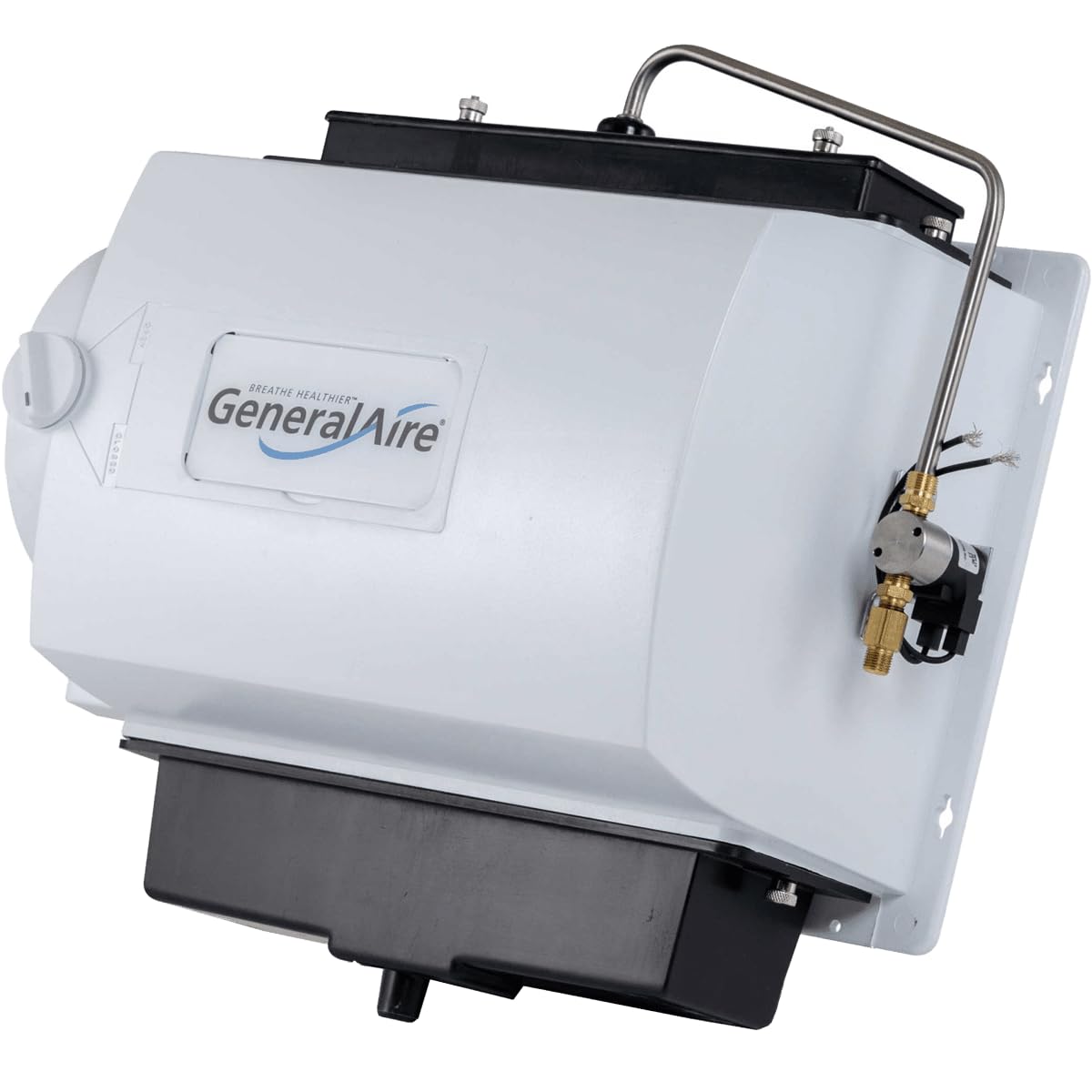
If you’ve been pricing whole-house humidifiers — the kind that attach to your furnace and push moisture through every room at once, rather than a tabletop unit you refill by hand — you’ve probably seen Aprilaire and Honeywell everywhere. What you may not have seen is GeneralAire, even though HVAC technicians and custom-home builders have been specifying it for decades. That’s not an accident. General Filters Inc., the Michigan-based company behind the GeneralAire name, built its distribution around wholesale HVAC suppliers and contractor accounts, not big-box retail shelves. The result is a product line with genuine engineering depth that most homeowners stumble onto only when a contractor puts it on a proposal — and then they have to research it from scratch. This guide is designed to close that gap. We’ll cover what the lineup actually is, where it wins and where it doesn’t, and how to make the right call whether you’re a homeowner comparing bids or a contractor defending a spec.
| EDITOR'S PICK[GeneralAire Model 5500 Steam Hu…](https://www.amazon.com/dp/B08CPJHVWJ?tag=greenflower20-20) | Mid-tier[GeneralAire 1042LH Legacy Humid…](https://www.amazon.com/dp/B0069VWNU4?tag=greenflower20-20) | Budget pick[GeneralAire Model 3200M Evapora…](https://www.amazon.com/dp/B08CY2Y5G6?tag=greenflower20-20) | |
|---|---|---|---|
| Type | Steam | Bypass | Evaporative |
| Power | — | 24V | — |
| Humidistat | — | — | Manual |
| Mount | — | Furnace | — |
| Price | $954.19 | $180.00 | $141.00 |
| See on Amazon → | See on Amazon → | See on Amazon → |
What GeneralAire Actually Makes (and How the Lineup Is Organized)
GeneralAire’s residential and light-commercial catalog breaks into three functional tiers, each serving a different installation scenario. Understanding the tiers matters because the model numbers alone aren’t self-explanatory.
Bypass evaporative humidifiers are the entry point. These units — the 1000 series and the 1042 are the most commonly specified — mount to the supply or return plenum (the sheet-metal box that distributes conditioned air from your furnace) and use the furnace’s own air pressure to push a small volume of warm air through a water panel. The water panel is a replaceable pad that holds water; air passing through it picks up moisture and carries it into the duct system. No separate fan is required, which keeps installation simple and operating costs low. The tradeoff is that bypass humidifiers only run when the furnace is actively heating — a limitation that becomes a real problem with high-efficiency furnaces that run longer cycles at lower temperatures, and a serious problem with heat pumps.
Fan-powered evaporative humidifiers add an internal blower so the unit can run independently of furnace fan cycles. The GeneralAire Elite GFI (model 1137) is the flagship here — it’s the unit most comparable to the Aprilaire 600 and Honeywell HE360 on the evaporative side, and it’s the one contractors tend to reach for when heat-pump compatibility or tighter humidity control is on the spec. Published specs from General Filters’ product sheets put the Elite GFI at up to 18 gallons per day (GPD) output — meaning it can add 18 gallons of moisture to your home’s air in a 24-hour period under rated conditions. That’s a meaningful number for sizing against the square footage and construction type of a given home.
Steam humidifiers are the premium tier. The GeneralAire GF series steam units heat water electrically to produce true steam, which is then distributed through a dedicated steam distributor installed in the supply duct. Steam doesn’t depend on furnace operation, doesn’t require the air to be warm to carry moisture, and delivers precise output regardless of outdoor temperature. The GF 1458 and GF 1458H (with hot-water connection) are the contractor-facing products in this category. Per General Filters’ published specification sheets, the GF 1458 is rated for up to 11.5 GPD — modest relative to the Aprilaire 800’s 34.6 GPD ceiling, but sized appropriately for homes in the 2,000–3,500 square foot range that make up the bulk of custom residential work.
The Contractor-Channel Advantage (and What It Costs You)
GeneralAire’s distribution model is its most important feature and its biggest friction point for homeowners trying to buy direct.
The brand is sold almost exclusively through HVAC wholesale distributors — companies like Winsupply, Johnstone Supply, and regional independents that serve licensed contractors. That means street pricing is genuinely hard to find online, and authorized-dealer status is tied to the wholesale account, not to a consumer marketplace. This matters because of warranty exposure: General Filters’ warranty terms, consistent with the pattern ACHR News described in its 2024 contractor-preference feature, are generally honored through the installing contractor or wholesale channel. A unit purchased through an unauthorized online marketplace may arrive in a gray-market chain that complicates warranty service — the same dynamic that Aprilaire’s Amazon Marketplace policy (which voids coverage on third-party Amazon sellers) made famous.
The practical upside is that contractor pricing through the wholesale channel is often meaningfully lower than the retail price on equivalent Aprilaire or Honeywell units. Owners in long-run installer reviews and contractor forums consistently note that a GeneralAire Elite GFI installed by a preferred-contractor account can come in $75–$150 below an equivalent Aprilaire 600M installation from the same HVAC company — because the contractor’s cost basis is lower and the margin structure is different. That’s not universal, and you won’t get that price buying it yourself.
By the numbers — mid-tier evaporative comparison (published specs, 2025–2026 pricing estimates):
| Model | Type | GPD (rated) | Approx. contractor-installed cost |
|---|---|---|---|
| GeneralAire Elite GFI 1137 | Fan-powered evaporative | 18 GPD | $550–$750 |
| Aprilaire 600M | Fan-powered evaporative | 17 GPD | $600–$850 |
| Honeywell HE360A | Bypass evaporative | 17 GPD | $400–$600 |
Pricing reflects mid-market contractor estimates as of May 2026; actual costs vary by region and labor rate.
Where GeneralAire Wins, Where It Doesn’t
Water panel design and filter serviceability are areas where GeneralAire has earned consistent praise from HVAC technicians in long-run service reviews. The 1042 and Elite GFI use a scale-control water panel design that General Filters has iterated on for decades; technicians report that the panel geometry and water distribution tend to produce less hard-water scaling on the unit’s interior components compared to some competitor designs, particularly in moderately hard water (roughly 7–14 grains per gallon). Building Science Corporation’s guidance on moisture control notes that maintenance intervals — not just rated output — are a primary driver of real-world humidification performance; a system that clogs at six months underperforms its spec sheet regardless of GPD rating. GeneralAire’s water panels are rated for annual replacement under normal water conditions, consistent with industry standard.
Steam unit water quality sensitivity is the honest counterpoint. The GF series steam humidifiers, like all electrode-boiler or resistive-element steam units, are sensitive to mineral content in the water supply. In high-hardness markets (above 14–20 grains per gallon), scale buildup on heating elements accelerates, and ASHRAE Standard 160-2021 effectively reinforces the long-standing industry guidance that steam humidifiers in hard-water installations benefit from either softened water supply or a periodic descaling protocol. General Filters’ own installation documentation for the GF 1458 recommends a licensed water treatment assessment where hardness exceeds local thresholds — a call that adds real cost to the steam value proposition that the GPD comparison alone won’t show you.
Smart-thermostat compatibility is a mixed picture. The Elite GFI and most GeneralAire evaporative units use a standard 24VAC humidistat or humidifier terminal connection, which means they wire cleanly to an Ecobee SmartThermostat with the HUM terminal or to a Honeywell T10 Pro using its dewpoint protection mode. Nest integration is functional but requires attention: Nest’s HUM terminal behavior sends a simple on/off signal that works with GeneralAire units but doesn’t pass GPD demand data back to the humidifier’s onboard controls — a limitation shared with essentially every non-proprietary humidifier on the market, not specific to GeneralAire. Where GeneralAire lags relative to Aprilaire is in ecosystem integration: Aprilaire’s 8910W Wi-Fi thermostat and its IAQ controller create a closed-loop system with the 600M and 800 series that GeneralAire doesn’t currently match with a comparable first-party smart controller. For homeowners building a Savant or Control4 integration, this matters; for most residential applications, it doesn’t.
Heat-Pump Compatibility: The Question That Decides the Tier
If your home is heated by a heat pump — or if you’re specifying a new system and the homeowner is on a heat-pump trajectory — the bypass units (GeneralAire 1042 and comparable) should be off the table. Bypass humidifiers require a temperature differential between the supply air and the return air to drive evaporation; heat pumps deliver supply air at 90–100°F rather than the 120–140°F a gas furnace produces, and the physics of evaporation at those temperatures significantly reduce real-world output relative to the rated GPD. Building Science Corporation’s Lstiburek-era guidance on heat-pump moisture management, still widely cited by IAQ consultants, notes that fan-powered evaporative or steam is the appropriate specification for heat-pump homes.
The GeneralAire Elite GFI’s integrated blower partially addresses this: because the unit moves air through the water panel under its own power rather than relying on supply-air temperature differential, it performs more consistently across a wider temperature range. It’s not rated for heat-pump applications by General Filters in the same explicit language Aprilaire uses for the 600M, but the operational principle is the same. For full heat-pump compatibility with no performance asterisk, the GF series steam is the defensible spec.
The Decision Framework
GeneralAire is the right call in three scenarios and the harder sell in two.
Choose GeneralAire when:
- Your HVAC contractor has a wholesale account and can pass through the pricing advantage — get a line-item cost comparison against the Aprilaire equivalent before committing.
- You’re in a moderate-hardness water market (under 14 GPH) and can commit to annual water-panel replacement; the evaporative line’s serviceability and scale-control design hold up well in those conditions.
- You’re a contractor building a preferred-vendor relationship and want a technically solid product with a lower jobsite cost basis than the market leaders.
Think harder before choosing GeneralAire when:
- You need first-party smart-home integration or a closed-loop IAQ controller — Aprilaire’s ecosystem is more developed.
- You’re in a high-hardness water market specifying steam — the GF series will need a water treatment plan built into the proposal, and the cost delta versus an Aprilaire 800 with a similar treatment plan narrows.
- You want to buy and research online before a contractor visit — the thin consumer-facing retail presence means you’re working harder for spec documentation than you would with Aprilaire or Honeywell.
The contractor brand positioning that kept GeneralAire off homeowner radar for decades is also what makes it genuinely worth knowing. For a contractor writing a proposal or a homeowner with a contractor willing to source it, the Elite GFI in particular represents one of the cleaner value propositions in the fan-powered evaporative tier. The name recognition gap is a distribution artifact, not a quality signal — and in this category, that’s a meaningful distinction.