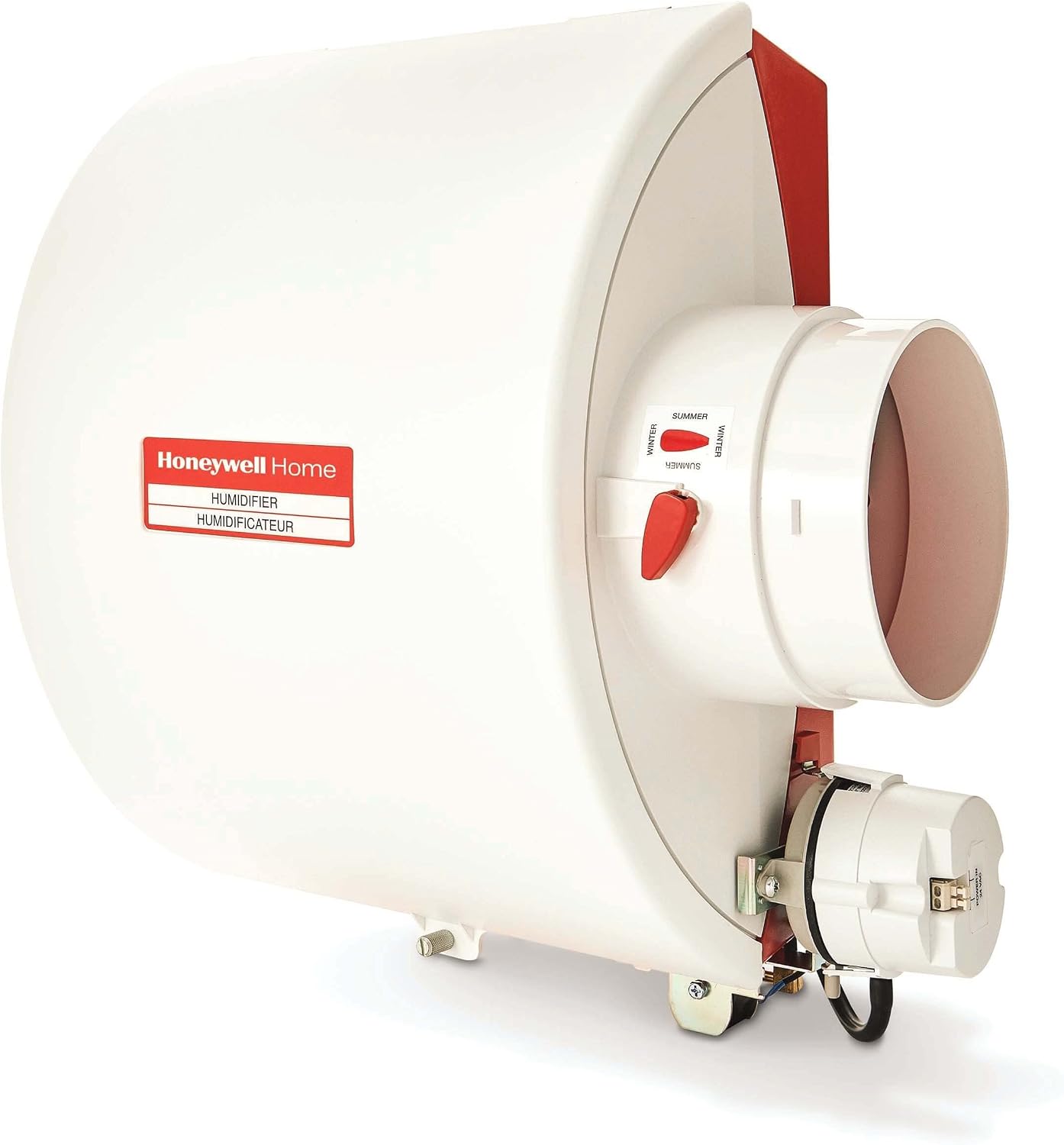
If you’ve been shopping for a whole-house humidifier, you’ve probably hit a wall of model numbers that look nearly identical — same beige cabinet, same vague “covers up to X square feet” claims — and wondered what you’re actually paying extra for. Here’s the short version before we get into the weeds: a whole-house humidifier connects directly to your home’s heating system (the furnace and the ductwork that carries warm air through every room) and adds moisture to the air automatically, winter-long. It’s the alternative to dragging a portable unit from room to room and refilling it every 36 hours. The Honeywell HE200, HE280, and HE300 are all bypass humidifiers, meaning they use the pressure difference between your furnace’s supply and return ducts — rather than their own fan — to push air across a water panel. That distinction matters for which homes they’ll actually work in, and it’s the first fork in your decision tree.
The three models share a family resemblance but sit at genuinely different capability levels. This guide decodes the real differences, names the tradeoffs your salesperson probably skipped, and gives you an “if X, then Y” rule at the end so you can close this tab and move forward.
The Numbers First: Capacity Side by Side
Rated output is the headline spec for any humidifier, but the manufacturer’s GPD (gallons per day) number assumes ideal conditions — a fully operational 80°F supply plenum, clean water, and a brand-new water panel. Real-world output runs roughly 20–30% lower over a season, per installation guidance from Resideo Technologies (Honeywell Home’s parent company since the 2018 brand split).
| Model | Rated Output (GPD) | Suggested Home Size | Water Panel Type | HumidiPRO Stat Compatible |
|---|---|---|---|---|
| HE200 | 12 GPD | Up to 2,000 sq ft | Evaporative pad | No (manual humidistat only) |
| HE280 | 17 GPD | Up to 4,000 sq ft | Evaporative pad | No (manual humidistat only) |
| HE300 | 18 GPD | Up to 4,200 sq ft | Evaporative pad | Yes (digital, outdoor-temp sensing) |
The capacity jump from HE200 to HE280 is meaningful. The jump from HE280 to HE300 is almost entirely about control logic, not output. If you’re deciding between the top two, you’re largely buying smarter humidity management, not more humidity.
What “Bypass” Actually Means for Your Install — and Why It Matters for Heat Pumps
A bypass humidifier doesn’t have its own motor. It relies on your furnace’s air handler to do the work. A small duct — the bypass duct — runs between your supply plenum (the hot-air distribution box above the furnace) and the return side of the system. When the furnace blower runs, pressure difference pushes a fraction of that heated air through the humidifier cabinet, across a wet water panel, and back into the return duct as humidified air.
The critical word there is heated. Bypass humidifiers work best when the supply air is warm — ideally 100°F or above. That temperature drives evaporation from the water panel. If your system runs at lower temperatures, evaporation rate drops sharply.
This is where heat pumps create a real problem. In heating mode, a standard air-source heat pump delivers supply air in the 90–105°F range under ideal conditions, but that number falls as outdoor temperatures drop — exactly when you need humidity most. ACHR News’s 2022 overview of humidifier-system matching notes that bypass units routinely underperform on heat pump systems during shoulder seasons because supply temperatures hover in the 80–95°F band, cutting effective GPD output by 30–40% compared to a gas furnace. If your home runs on a heat pump as the primary heat source, the HE200, HE280, and HE300 are all working against physics. A fan-powered unit — or a steam humidifier — is the better architecture for that load.
For gas furnace homes, bypass humidifiers remain solid workhorses. The math just works differently.
HE200 vs. HE280 vs. HE300: The Actual Decision Tree
HE200: The Entry Point, Honestly Scoped
The HE200’s 12 GPD rating puts it comfortably in the range for homes under 1,800–2,000 square feet with good envelope tightness (meaning a well-sealed house that doesn’t lose humidity quickly through drafts). Owners in online HVAC forums consistently describe it as a reliable workhorse for smaller, newer builds — simple to maintain, straightforward to wire to a basic 24V humidistat.
What you give up: there’s no provision for outdoor temperature sensing or digital control. You set the humidistat manually and adjust it seasonally. This matters because indoor humidity targets need to change as outdoor temperatures change — if you maintain 45% RH inside when it’s -10°F outside, you’ll see condensation and potential moisture damage on your windows and wall cavities. Building Science Corporation’s research report on relative humidity in houses (RR-1201) makes this relationship explicit: the colder it gets outside, the lower your indoor humidity target needs to be to prevent condensation at the building envelope.
With a manual humidistat, you are the outdoor temperature sensor. That’s not a deal-breaker — it just requires a seasonal habit.
The HE200 is the right call if: your home is under 2,000 square feet, your climate is relatively mild, and you’re comfortable adjusting the dial a few times a winter.
HE280: More Capacity, Same Manual Control
The HE280 steps up to 17 GPD — a 42% increase over the HE200 — which is enough to serve homes in the 2,500–3,500 square foot range, assuming reasonable construction tightness. The cabinet and installation footprint are nearly identical to the HE200, so there’s no install complexity premium if you’re already doing the bypass duct work.
The honest tradeoff: you’re still getting a manual humidistat experience. The HE280 costs more than the HE200 but doesn’t add control sophistication. If your home is large enough to need 17 GPD but you’re also planning to wire it to an Ecobee or Nest thermostat with a dedicated humidity terminal, be aware that neither stat offers the outdoor-lockout logic that Honeywell’s own HumidiPRO stat adds. You can get close by enabling frost-control features in Ecobee’s settings, but that’s a workaround, not a native integration. HVAC School’s published guides on smart thermostat humidifier wiring are worth reading before you commit to any specific wiring scheme.
The HE280 is the right call if: your home is in the 2,500–4,000 square foot range on a gas furnace and you’re fine managing humidity manually or through a third-party smart thermostat that handles frost control separately.
HE300: The Control Story, Not the Capacity Story
The HE300’s 18 GPD output is effectively the same as the HE280’s. The price premium you’re paying is for the HumidiPRO digital humidistat — a wall-mounted controller that reads outdoor temperature from a wired sensor and automatically adjusts your humidity setpoint to stay below the condensation threshold. That’s the feature that makes seasonal manual adjustment unnecessary.
The HumidiPRO integration also means the HE300 has a cleaner path to whole-home IAQ systems. Resideo’s authorized dealer documentation describes the HumidiPRO as compatible with their broader comfort control ecosystem. It’s not a full smart-home integration — you won’t find native HomeKit or Z-Wave — but for homeowners who want set-it-and-forget-it reliability without building a custom wiring solution, the included controller earns its cost.
One important note on purchasing: Resideo’s Authorized Dealer Program Terms (2024 edition) explicitly warns that units purchased from unauthorized marketplace sellers — including third-party sellers on major retail platforms — may not carry valid manufacturer warranty. This is the same policy pattern that has tripped up Aprilaire buyers on certain platforms. For a unit you’re going to rely on for 8–12 years, buying through an authorized HVAC distributor or a Resideo-registered dealer isn’t optional if warranty coverage matters to you.
The HE300 is the right call if: your home is over 3,000 square feet, you want automatic outdoor-temperature compensation without custom thermostat wiring, and you’re buying through a legitimate authorized channel.
Maintenance Reality: Water Quality Is the Hidden Variable
Every bypass humidifier’s operating cost and service life hinge on water hardness more than any other variable. The evaporative water panel — the corrugated pad that water trickles across — accumulates mineral scale from dissolved calcium and magnesium as water evaporates. In hard-water markets (above 7 grains per gallon, which covers most of the Midwest, Southwest, and Mountain West), water panels in the HE200, HE280, and HE300 typically need annual replacement. In moderately hard water (4–7 GPG), you might stretch to 18 months. In genuinely soft water, two years is credible.
Honeywell’s installation and maintenance guides for all three models specify the HC22 or HC26 water panel (the HE300 uses the larger panel). As of May 2026, replacement panels run roughly $18–$30 through authorized distributors depending on the model. That’s not a punishing cost, but it’s real cost-of-ownership that the box price doesn’t reflect.
If your water is above 10 GPG, consider adding an inline sediment filter upstream of the humidifier supply line. It won’t eliminate scale, but it will meaningfully extend panel life. ASHRAE Standard 160-2021 addresses moisture control broadly but notes that equipment performance degradation from mineral accumulation is a documented failure mode in evaporative systems — worth citing when a contractor tells you maintenance is “basically nothing.”
The Decision Frame, Stated Plainly
Here’s the “if X, then Y” summary:
- If your home is under 2,000 sq ft, gas furnace, and you’re comfortable with seasonal manual adjustments → HE200. Lowest cost, lowest complexity, fully adequate for the application.
- If your home is 2,000–4,000 sq ft, gas furnace, and capacity is the constraint → HE280. Take the GPD bump; live with manual control or handle outdoor compensation through your smart thermostat.
- If your home is 3,000–4,200 sq ft and you want automatic humidity management without custom wiring → HE300. The HumidiPRO stat earns its premium. Buy through an authorized dealer.
- If your primary heat source is a heat pump → none of the above. Revisit fan-powered models or steam. The bypass architecture won’t serve you well when supply temperatures drop.
- If your water is hard (above 7 GPG) → budget $25–$35/year per unit for water panel replacement regardless of which model you choose. It’s not optional; it’s maintenance.
The Honeywell bypass lineup is a mature, well-documented product family. The specs are honest, the install manuals are thorough, and the units have a long enough track record that owners can tell you what a second or third panel replacement cycle actually looks like. What they can’t do is transcend the physics of bypass humidification — and that’s the tradeoff worth naming before you buy.