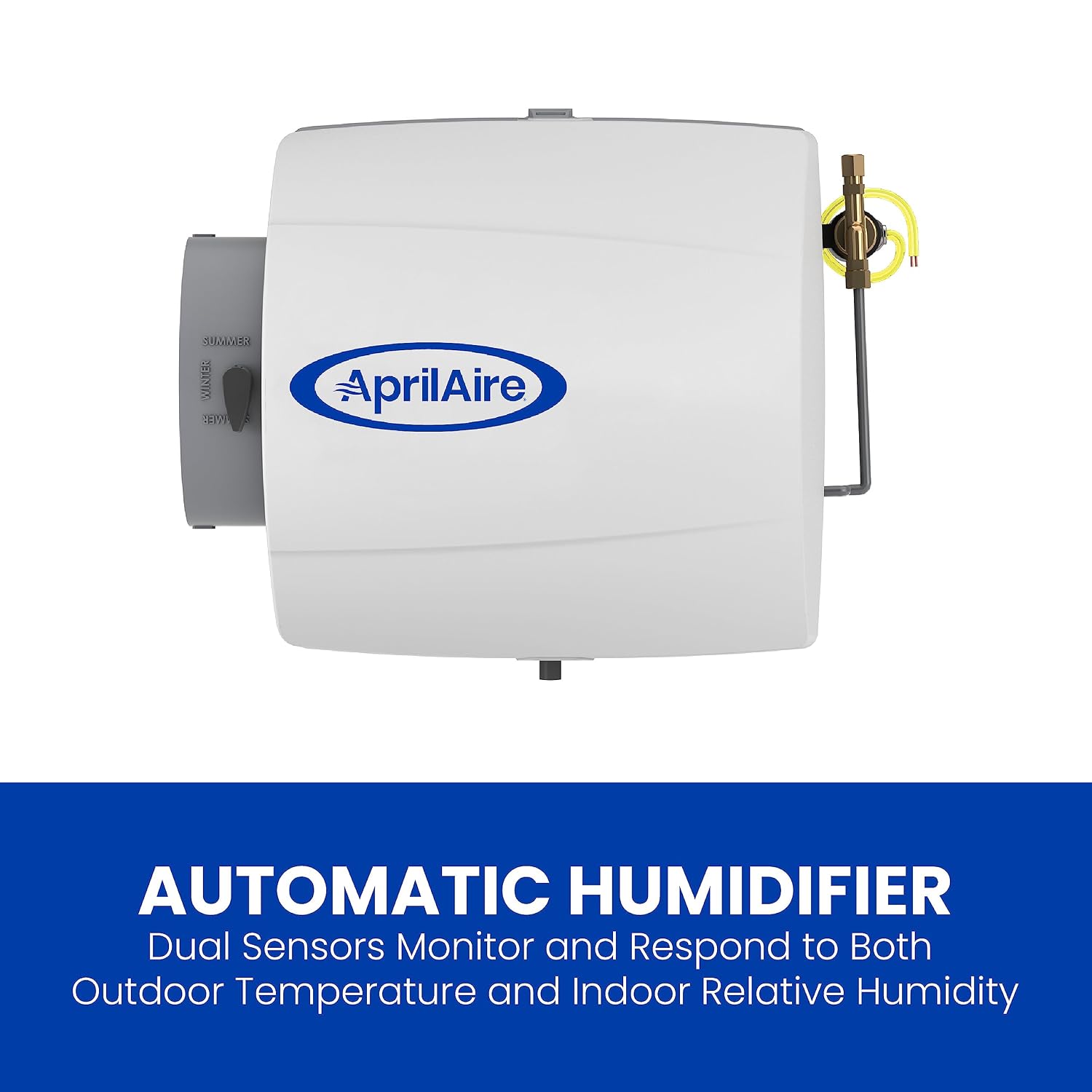
A whole-house humidifier is a device plumbed into your home’s forced-air heating system — the network of ducts that carries warm or cool air from a central furnace or air handler — to add moisture to the air throughout every room at once. Unlike the plug-in units you find at a big-box store, these systems run automatically and are sized to treat thousands of square feet. They fix genuinely miserable problems: static shocks, cracked wood floors, scratchy sinuses in January. But here’s what nobody puts in the brochure: the purchase price is often the smallest number in the five-year story. A $200 bypass humidifier (one that borrows airflow pressure from the duct system rather than running its own fan) can easily cost $400–$600 more over five years in pads, wasted water, and electricity. A $900 steam unit can cost $1,500 more — or nearly nothing — depending almost entirely on your water quality and whether you’ve budgeted for the canister. This article builds the full ledger so you can make the call with open eyes.
The Four Cost Buckets Every Owner Faces
Before we run the numbers by technology type, it helps to name the four recurring cost lines. Miss any one of them and your projection is wrong.
1. Consumables (pads and canisters). Evaporative bypass and fan-powered humidifiers use a water panel — often called an evaporator pad or vapor pad — that mineral deposits clog over one to three heating seasons. Aprilaire’s published maintenance guide for the 400 and 600 series recommends annual pad replacement; in hard-water markets (water with dissolved mineral content above roughly 10 grains per gallon), operators in long-run reviews note they replace pads mid-season too. Steam humidifiers use a plastic or polymer canister that the unit fills with water, boils, and slowly coats in scale. When scale buildup makes the heating element inefficient, the unit signals replacement. That canister is where most steam-humidifier owners experience sticker shock.
2. Water waste. Bypass humidifiers are “flow-through” designs: they run a continuous trickle of water across the pad and drain the mineral-laden overflow. Manufacturer spec sheets for common bypass units list drain rates of 1.5–3.5 gallons per hour of operation. In a Northern U.S. climate with a five-to-six-month heating season, that adds up to several thousand gallons of municipal water annually — water you pay for but never benefit from.
3. Electricity. This line is usually the smallest, but it’s non-zero and worth calculating. Fan-powered units add a small blower motor (typically 50–150 watts) that runs independently of the furnace fan. Steam units run resistance heating elements rated between 750 watts (small residential units) and 1,500+ watts for high-capacity models like the Aprilaire 865. Per the U.S. Energy Information Administration’s Electric Power Monthly (May 2026 edition), the U.S. average residential electricity rate sits around $0.17 per kWh, with Northeast and California markets running $0.25–$0.35.
4. Service labor. If you’re not doing your own annual maintenance, a technician visit to swap a pad or flush a steam canister typically runs $75–$150 in most markets. Over five years, that’s $375–$750 stacked on top of every other line.
By the Numbers: Five-Year Projection by Technology Type
These figures use a representative mid-size home (2,000–2,500 sq ft, moderately hard water at 12–15 grains per gallon hardness, Midwest climate with a 150-day heating season, furnace running 8–10 hours per day).
| Cost Category | Bypass Drum/Pad (e.g., Honeywell HE360) | Fan-Powered (e.g., Aprilaire 600) | Steam (e.g., Aprilaire 865) |
|---|---|---|---|
| Unit purchase (installed) | $200–$350 | $400–$600 | $900–$1,400 |
| Pads / canisters × 5 yrs | $60–$120 | $75–$150 | $500–$1,200 |
| Water waste × 5 yrs | $180–$400 | $120–$300 | $30–$80 |
| Electricity × 5 yrs | $20–$60 | $75–$180 | $350–$900 |
| Service labor × 5 yrs (DIY = $0) | $0–$750 | $0–$750 | $0–$750 |
| 5-Year Total (DIY / Pro) | $460–$1,680 | $670–$1,980 | $1,780–$4,330 |
The wide ranges reflect the two biggest variables: water hardness and whether you do your own maintenance. If you’re specifying for a client in Phoenix or Las Vegas — cities with water hardness commonly exceeding 20 grains per gallon — compress those ranges toward the top. If the home has a water softener already, shift them toward the bottom.
The Canister Problem: Steam Humidifiers’ Hidden Ledger Line
The steam canister deserves its own section because it’s the line item that generates the most surprise in year two or three. Here’s the mechanics: a steam humidifier heats tap water inside a sealed polymer canister until it boils, then pushes steam into the duct. Every cycle, some water evaporates cleanly and some minerals stay behind. Over time, scale coats the electrodes (in electrode-style units) or the heating element (in resistance units), reducing efficiency until the unit either throws a fault code or stops producing at rated capacity.
Replacement canister costs as of 2026: roughly $80–$150 for Aprilaire 800-series canisters, $100–$200 for GeneralAire Elite GFI canisters, and $150–$300+ for commercial-adjacent units like the Nortec NHMC series, per published parts pricing from authorized distributors. In hard-water markets, owners in long-run aggregated reviews report replacing canisters every 12–18 months. In soft-water markets — or homes with a whole-home water softener — the same canister can last three to five years.
The math is unforgiving: a homeowner in Scottsdale replacing a $120 canister every 14 months pays roughly $515 in canisters alone over five years, before touching any other cost line. That same unit in a Milwaukee suburb with moderately soft water might spend $160 total. Water quality is not a footnote. It’s the swing factor.
Building Science Corporation’s BSD-013 moisture control guidance notes that water treatment decisions upstream of any humidification appliance substantially affect both equipment longevity and indoor air quality — scale particulates from failing steam canisters can degrade air quality in ways that defeat the purpose of the system entirely.
Where Bypass Units Win (and Where They Don’t)
If the five-year steam numbers made you wince, the bypass drum unit’s $460–$1,680 range probably looks appealing. It is — with conditions.
Bypass humidifiers are honest workhorses when the furnace fan is running anyway (i.e., in climates that need heat regularly). Their core limitation, documented in installation manuals and contractor feedback across trade publications including ACHR News, is compatibility with heat-pump systems. A bypass humidifier relies on the temperature differential between supply and return air to evaporate water off the pad. Heat pumps deliver supply air at 90–100°F in heating mode, compared to 120–140°F from a gas furnace. At lower supply temperatures, evaporation efficiency drops sharply — you may get 40–60% of rated GPD (gallons per day) output. This Old House’s humidifier selection guidance flags this directly: bypass units are “best suited for gas or oil furnaces, not heat pumps.”
Fan-powered units (with their own blower) solve the heat-pump problem. They generate airflow across the pad independently. The cost premium over a basic bypass unit — roughly $200–$300 installed — pays for itself in this scenario before year two.
The tradeoff to name clearly: fan-powered units cost more to run electrically and have slightly more components to service. For gas-furnace homes that don’t need the extra blower, a quality bypass unit with annual pad replacement is the lowest-friction, lowest-cost option across five years.
Smart Thermostat Integration: A Cost Factor Nobody Lists
This one is easy to overlook in a cost analysis, but it belongs here. ASHRAE Standard 55-2023 recommends indoor relative humidity between 30% and 60% for occupant comfort. Maintaining that range precisely — rather than running the humidifier on a fixed schedule — saves water, saves electricity, and extends pad and canister life. The mechanism is a humidistat: a sensor that tells the humidifier when to run.
Basic humidistats included with most units are notoriously imprecise. Operators in aggregated reviews consistently note ±5–10% humidity swings with stock controls.
Connecting your humidifier to an Ecobee, Nest, or Honeywell T10 thermostat with a dedicated humidity terminal delivers tighter control — and in Ecobee’s case, frost-point limiting (a feature that automatically reduces humidity setpoints when outdoor temperatures drop, preventing condensation on cold windows). Tighter control typically means 10–20% fewer operating hours, which compresses every recurring cost line. The integration cost is roughly $50–$150 in wiring and configuration time — a payback period measured in one heating season for most homes.
One contractor caution worth passing on, sourced from trade discussions in Contracting Business magazine: the Nest’s HUM terminal behavior differs from Ecobee’s in ways that can cause short-cycling on fan-powered humidifiers. Verify compatibility with the specific humidifier model before specifying this combination to a client.
The Decision Rule
If the math above felt abstract, here’s the decision frame distilled:
If your client has a gas furnace, moderately soft water (under 10 grains per gallon), and wants lowest total five-year cost: A fan-powered evaporative unit like the Aprilaire 600 is the call. Pad costs are predictable, water waste is moderate, and the unit is serviceable by any HVAC tech. Budget $700–$900 installed and $200–$400 in consumables over five years.
If the home has a heat pump or geothermal system: Skip bypass entirely. Fan-powered or steam only.
If water hardness exceeds 15 grains per gallon and no softener exists: Model the canister replacement cost before specifying steam. Either budget for a pre-filter or point-of-use softener upstream of the humidifier, or recommend a fan-powered evaporative unit and budget for semi-annual pad swaps instead. The evaporative pad at $25–$40 is far cheaper to replace than a $120–$200 steam canister.
If precise humidity control and smart-home integration are primary requirements and water quality is acceptable: Steam is the right answer. Accept the higher consumable cost in exchange for output that doesn’t depend on furnace temperature, supply-air humidity, or duct configuration. The Aprilaire 865 and GeneralAire Elite GFI are the units most commonly specified in this segment, and their published output ratings hold up across a wider range of conditions than bypass or fan-powered units.
For every scenario: Get a water hardness test before specifying. Your local water utility publishes annual water quality reports — that number sets the canister and pad replacement cadence more accurately than any rule of thumb. The $15 cost of a home water test is the best pre-purchase dollar you’ll spend.
The upfront price is a one-time event. Water hardness, pad schedules, and canister cycles run for as long as the unit does. Build the five-year ledger first, then pick the unit.